
I watched an episode of “You Quiz on the Block(Korean talk show)” where a professor from Yonsei University talked about how to stop procrastinating.
He even gave us a little procrastination quiz to take!
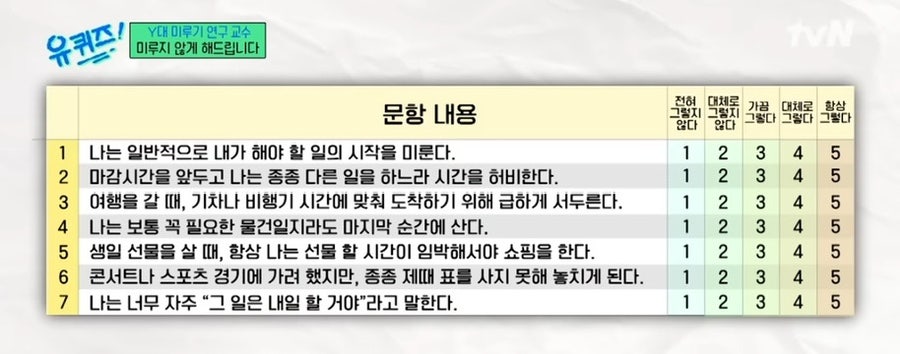
- Up to 15 points: You’ve got solid time management down.
- 16-24 points: You’re on the edge; keep an eye on that.
- 25+ points: Professor says, “Come see me.” 😂
Well, guess who scored a 29?
Yeah, me… I know, it’s bad. 😅
But there was one piece of advice that really stuck with me:
“Break your time into 15-minute blocks.”
At first, I was like, “That’s way too short, right?” But actually, there’s a reason this works:
- Your time perception sharpens. 15 minutes might seem short, but when you focus, you can get a lot done. It’s a mental training thing. You learn to concentrate for short bursts, which is actually super effective in the long run.
- You waste less time. Like, instead of thinking, “Okay, I have 17 minutes before my next meeting… Let me scroll through Instagram,” you can switch that to something like, “I’ve got 15 minutes, let me cram in some vocab practice.” The point is, you stop just letting those minutes slide by. You turn every block into something productive.
- Breaking tasks down reduces the pressure. Instead of thinking, “Ugh, I have to write this massive paper,” you could think, “Alright, in 15 minutes, I’ll write the intro to my paper.” Breaking big tasks into bite-sized pieces makes it way easier to start. Trust me, it works.
Apparently, over 50% of people in Korea are perfectionists (yep, including me… ).
I can knock out small tasks easily, but when it comes to bigger ones, I procrastinate because I’m worried I won’t do it perfectly. And guess what? That’s exactly what causes delays.
So, if I focus on 15-minute chunks, it’ll be easier for those of us (ahem, me) who tend to procrastinate because of perfectionism to get things done—and stop wasting time on unnecessary stuff.
- Execution improves. The best thing about 15-minute blocks? You get quick feedback. If something didn’t go as planned, you just adjust for the next 15 minutes. So the cycle of planning and executing speeds up, and you get better at following through.
Effective time management isn’t just about managing your hours. It’s about cutting out the waste and filling your time with things that actually matter.
And let’s be real, most of that wasted time comes from procrastination, right?
So, break your time into 15-minute blocks and plan ahead—that’s the trick to reducing procrastination.
But there’s one other super important step: Making plans.
If you don’t have a plan, even if you have a million things to do, you’ll waste so much time figuring out what to tackle first. And if you don’t have anything planned at all? You’ll end up wasting even more time deciding what to do.
Of course, there’s also the concentration issue. If your focus is all over the place, it’s hard to improve it in a short time, so don’t expect a quick fix. But still, these two methods are solid, and you can start using them right away:
- Break your time into 15-minute blocks.
- Plan ahead.
These are simple steps, and I think they’ll work for me. So, I’ve started writing my daily tasks in these blocks. It’s helping me get used to the idea of breaking things down and building a better habit.
But, let’s be real… 15 minutes still feels way too short for me. 😂
I’m a procrastination queen, so I’m starting with 30-minute blocks first, and then maybe I’ll go down to 15 once I get used to it. Gotta crawl before you can walk, right?
Anyway, if you’re curious about how I’m doing with my first project—waking up earlier—or my mini-project on time management and planning, check out my “daily track” categories! 😍
Thanks for reading, as always! Don’t forget to follow, comment, and share if you liked it! ✨
 Glow-up guide
댓글 남기기